summer vacation has arrived, making museums an ideal choice for outings. Joining the镜头 of CCTV reporters, let's visit some distinctive museums.
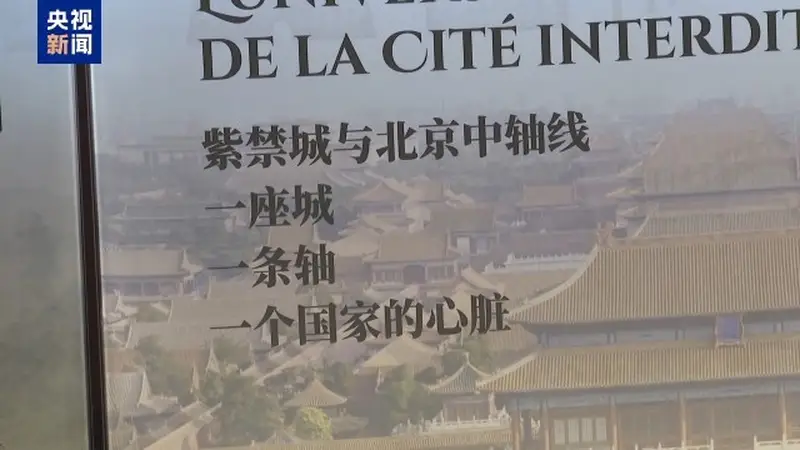
This summer, an immersive exhibition co-created by a Chinese-French team made its appearance in Paris, bathed in light and shadow. The exhibition centers on Beijing from the 15th to the early 20th century, drawing on immersive projections, interactive installations, and a cultural experience route to gradually reveal the beauty of the Forbidden City and its historical context to French audiences.
CCTV reporter Zhu Xuesong: Here we are at the Musée de l'Histoire de Paris, located in the western suburbs of Paris, known as the "City of History." Historically, this museum focused solely on French history. But this summer, it welcomes the Forbidden City, a Chinese palace with over 600 years of history. No artifacts were shipped overseas; instead, organizers use images to narrate the history of this Chinese palace to French audiences.
CCTV reporter Zhu Xuesong: Upon entering, the exhibition begins with the Beijing Central Axis. For cities like Paris in the West, urban development often follows terrain and rivers, resulting in scattered streets with no overarching line. However, as early as more than seven centuries ago, Beijing had already established a central axis, with the city symmetrically built around it, the Forbidden City at its heart. This orderly approach—first establishing a line, then building the city—is something many French visitors had never encountered before, and it's one of the most captivating aspects of the Forbidden City in their eyes.
CCTV reporter Zhu Xuesong: The entire exhibition is dominated by digital and visual elements, though it retains some real-life displays. In my hand is a dougong, a tiered wooden component in traditional Chinese architecture. Piece by piece, these wooden elements fit together tightly without a single nail, capable of supporting the roof. The palaces of the Forbidden City rely on thousands upon thousands of such dougong. The organizers特意 chose to display them in real life, allowing visitors to feel the authentic texture of Chinese ancient buildings up close.
French visitor Yohan Snoual: What impressed me the most was learning the details of these palace buildings. We could see various colors, like the red and golden bricks, the golden roof tiles—it was very interesting. We gained a lot of knowledge about architecture. I really want to visit China. China is so large—I'm sure there must be diverse landscapes and ancient sites to see.
CCTV reporter Zhu Xuesong: Throughout the exhibition hall, touch screens are plentiful. With a click, visitors can easily grasp rich historical knowledge about the emperors, ceremonies, and more within the Forbidden City. Over here, an entire wall showcases a timeline comparing the history of China and France. In 1682, the French court moved into Versailles. The same year, French missionaries first entered the Forbidden City, marking the beginning of exchanges between China and France. The Palace of Versailles and the Forbidden City, separated by half a globe, had their first encounter in the same era.
French visitor Marie Ginat: From a historical perspective, this is also very interesting. When the Forbidden City was under construction, France was largely in the era of Gothic cathedral building. These are two completely different architectural styles, but both are equally magnificent.
CCTV reporter Zhu Xuesong: Several hundred years ago, the Forbidden City was a strictly closed imperial palace, accessible to ordinary people. Now, it has reached across the ocean to open its doors to French audiences. Many visitors told me after the exhibition that their immediate plan is to travel to China.






网友评论